
LLM API Price Changes 2026: Token Prices Up, Capability 50x Cheaper
Contents
- What happened to LLM API list prices in the past year?
- How did Anthropic, OpenAI, Google and DeepSeek price their models over two years?
- Did the models get more expensive or just more capable?
- How did pricing differ by tier?
- How did each lab’s pricing strategy differ?
- How does DeepSeek’s pricing strategy compare?
- How do the four labs compare?
- How did each category’s price move?
- How much does a given capability level cost now?
- Why did prices move this way?
- Why is price per token not price per task?
- How did cache prices change relative to input?
- What should you do with this?
- FAQ
- Related reading
LLM API list prices per token rose on 10 of 14 model tiers between October 2025 and October 2026, yet the cheapest model reaching a given capability level got 17 to 50 times cheaper per token at index levels 20 to 40, and 2.5 times cheaper at 50. A tier is one vendor’s product line, such as Claude Opus or Gemini Flash. Capability is a model’s score on the Artificial Analysis Intelligence Index, an independent benchmark composite scored 0 to 100 (the top model today scores 57.6). Prices are blended: dollars per million tokens, three input tokens to one output. Both trends hold because each new model in a tier is more capable than the one it replaced.
TL;DR
- Input list prices rose on 10 of 14 tiers from October 2025 to October 2026; all 3 that fell are Anthropic’s.
- The cheapest model scoring 40 on the Artificial Analysis index fell from $10 to $0.20 per million blended tokens, April to October 2026.
- Since October 2024 Anthropic cut all three tiers (Opus $15 / $75 to $4 / $20), Google raised all three, and OpenAI raised only its mid tier.
- Closed flagships’ input-price spread shrank from 12x to 2x; the open-weight flagship median doubled.
What happened to LLM API list prices in the past year?
Most tiers cost more per token than they did a year ago. We compared the model holding each tier on October 15, 2025, with the model holding it on October 15, 2026:
| Tier | Oct 2025 model, $ per million tokens (input / output) | Oct 2026 model, $ per million tokens (input / output) | Input price, 2026 vs 2025 |
|---|---|---|---|
| OpenAI flagship | GPT-5, $1.25 / $10 | GPT-6.1 Sol, $2 / $10 | 1.6x |
| OpenAI mid | GPT-5 mini, $0.25 / $2 | GPT-5.6 Terra, $2 / $12 | 8x |
| OpenAI small | GPT-5 nano, $0.05 / $0.40 | GPT-6 Luna, $0.10 / $0.50 | 2x |
| Claude Opus | Opus 4.1, $15 / $75 | Opus 5.5, $4 / $20 | 0.27x |
| Claude Sonnet | Sonnet 4.5, $3 / $15 | Sonnet 5.5, $2 / $10 | 0.67x |
| Claude Haiku | Haiku 4.5, $1 / $5 | Haiku 5.5, $0.10 / $0.50 | 0.1x |
| Gemini Pro | Gemini 2.5 Pro, $1.25 / $10 | Gemini 4 Argon, $2 / $10 | 1.6x |
| Gemini Flash | Gemini 2.5 Flash, $0.30 / $2.50 | Gemini 3.8 Flash, $0.75 / $3.75 | 2.5x |
| Gemini Flash-Lite | Gemini 2.5 Flash-Lite, $0.10 / $0.40 | Gemini 3.5 Flash-Lite, $0.30 / $2.50 | 3x |
| DeepSeek low-cost | V3.2-Exp, $0.28 / $0.42 | V4.1 Flash, $0.30 / $1.20 at peak hours | 1.07x |
| Zhipu GLM flagship | GLM-4.6, $0.60 / $2.20 | GLM-5.3, $1.40 / $4.40 | 2.3x |
| Moonshot Kimi flagship | Kimi K2, $0.60 / $2.50 | Kimi K3, $3 / $15 | 5x |
| Alibaba Qwen Max | Qwen3-Max, $1.20 / $6 | Qwen3.8 Max, $2 / $6 | 1.67x |
| MiniMax | M2 (from October 23), $0.30 / $1.20 | M3, $0.30 / $1.20 | 1x |
Some prices carry conditions: Argon and Gemini 3.8 Flash are introductory prices that double on December 1 and January 1, Haiku 5.5 costs $0.50 / $2.50 above 100,000 prompt tokens, and the DeepSeek row counts the peak price, charged during Beijing business hours (off-peak is half, below V3.2-Exp’s blended price). Counting blended prices instead of input prices also gives 10 of 14. Kimi K2 and Qwen3-Max prices come from third-party records.
How did Anthropic, OpenAI, Google and DeepSeek price their models over two years?
Over two years Anthropic cut list prices in all three of its tiers, OpenAI’s flagship and small model ended close to where they started while its mid tier rose 17x, Google raised every tier, and DeepSeek’s low-cost model rose about 3x at peak hours while its cache-hit price fell to 2% of input. The chart and tables below follow the three largest closed labs back to October 2024, tracking the current flagship, mid-tier and small model of each. DeepSeek sells one or two models rather than three tiers, so it has its own subsection, and a final table compares all four.
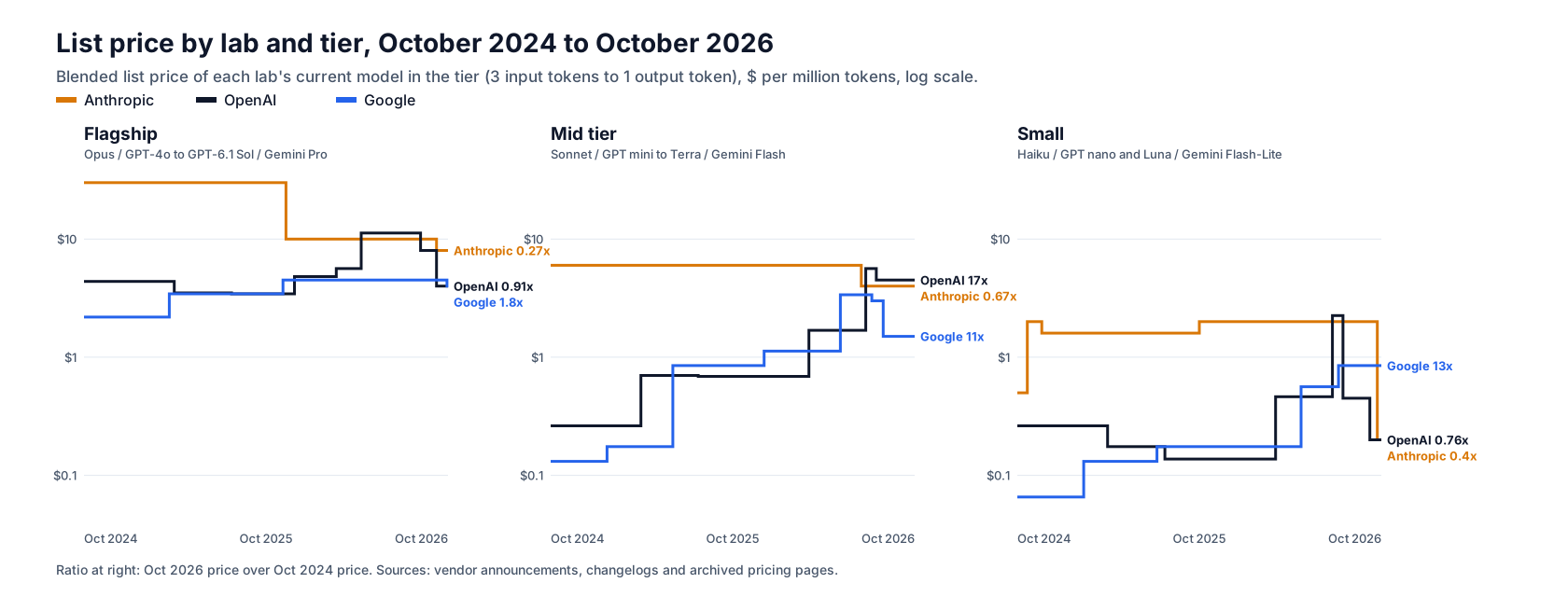
| Tier | Anthropic | OpenAI | |
|---|---|---|---|
| Flagship | Claude 3 Opus $15 / $75 to Opus 5.5 $4 / $20: 0.27x | GPT-4o $2.50 / $10 to GPT-6.1 Sol $2 / $10: 0.91x | Gemini 1.5 Pro $1.25 / $5 to Gemini 4 Argon $2 / $10: 1.8x |
| Mid tier | Claude 3.5 Sonnet $3 / $15 to Sonnet 5.5 $2 / $10: 0.67x | GPT-4o mini $0.15 / $0.60 to GPT-5.6 Terra $2 / $12: 17x | Gemini 1.5 Flash $0.075 / $0.30 to Gemini 3.8 Flash $0.75 / $3.75: 11x |
| Small | Claude 3 Haiku $0.25 / $1.25 to Haiku 5.5 $0.10 / $0.50: 0.4x | GPT-4o mini to GPT-6 Luna $0.10 / $0.50: 0.76x | Gemini 1.5 Flash-8B $0.0375 / $0.15 to Gemini 3.5 Flash-Lite $0.30 / $2.50: 13x |
Prices are on October 15 of each year, and the ratio compares blended prices. GPT-4o mini starts both of OpenAI’s lower rows because OpenAI had no separate small model until GPT-4.1 nano in April 2025.
Did the models get more expensive or just more capable?
The models mostly got more capable. From October 2025 to October 2026 the index score of each tier’s current model rose 1.9 to 3.3 times, and the price per index point (blended price divided by index score; below 1x means the same capability got cheaper) fell in seven of the nine tiers. The index scores older models only from mid-2025, so this comparison covers the second year:
| Lab and tier | Index, Oct 2025 to Oct 2026 | Blended price | Price per index point |
|---|---|---|---|
| Anthropic flagship | 22.8 to 57.6 | $30.00 to $8.00 | 0.11x |
| Anthropic mid tier | 19.3 to 35.9 (default setting) | $6.00 to $4.00 | 0.36x |
| Anthropic small | 16.9 to 43.4 | $2.00 to $0.20 | 0.04x |
| OpenAI flagship | 23.0 to 51.8 | $3.44 to $4.00 | 0.52x |
| OpenAI mid tier | 16.8 to 42.1 | $0.69 to $4.50 | 2.6x |
| OpenAI small | 13.0 to 38.1 | $0.14 to $0.20 | 0.50x |
| Google flagship | 16.1 to 52.6 | $3.44 to $4.00 | 0.36x |
| Google mid tier | 13.1 to 40.9 | $0.85 to $1.50 | 0.57x |
| Google small | 8.5 to 22.2 | $0.18 to $0.85 | 1.9x |
The models are the ones in the first table. Scores are at each model’s highest reasoning setting (the request option that lets a model think longer before answering); Sonnet’s use the default setting, the only one scored for older Sonnets, and the October 2025 scores of older models are Artificial Analysis estimates. The price per point rose only where a lab moved a model up the price ladder faster than it improved.
How did pricing differ by tier?
The flagship tier converged, the mid tier was repriced upward, and the small tier split. The highest flagship input price was 12 times the lowest in October 2024 (Claude 3 Opus at $15, Gemini 1.5 Pro at $1.25) and still 12 times in October 2025. Today it is 2 times; on the way, OpenAI’s flagship rose to $5 / $30 with GPT-5.5 in April 2026 before falling to $2 / $10. Mid-tier models now score above where flagships did a year earlier, and OpenAI and Google priced them that way, so the mid-tier input spread fell from 40x to 2.7x, with Sonnet’s cut narrowing it further. In the small tier OpenAI and Anthropic both settled on $0.10 / $0.50, while Google’s Gemini 3.5 Flash-Lite costs what Gemini 2.5 Flash did in mid-2025.
How did each lab’s pricing strategy differ?
Anthropic held prices for long stretches and cut in steps, OpenAI repriced often and credited each move to capability or efficiency, and Google raised prices each generation and announced increases in advance. None of the three named a competitor as the reason for a price change, even when Opus 5.5, GPT-6 Sol and GPT-6 Luna launched on the same day.
Anthropic: fixed prices, then step cuts. Sonnet stayed at $3 / $15 from March 2024 to Sonnet 4.6 in 2026, and Opus at $15 / $75 until Opus 4.5 cut it to $5 / $25 in November 2025, “making Opus-level capabilities accessible to even more users” (Anthropic). Later cuts came with new models: Opus 5.5 “requires less compute to serve than Opus 5, and its pricing reflects that” (Anthropic), and Sonnet 5’s introductory $2 / $10 became its standard price in August. Its increases were in the Haiku line: Claude 3.5 Haiku launched at $1 / $5 in November 2024 “to reflect its increase in intelligence” and was cut to $0.80 / $4 a month later (TechCrunch), and Haiku 4.5 went back to $1 / $5 in October 2025.
OpenAI: frequent repricing, credited to capability or efficiency. Increases came with capability claims: GPT-5.2 was “priced higher per token than GPT‑5.1 because it is a more capable model” (OpenAI). Cuts came with serving-cost claims: o3 fell 80% in June 2025 because “We optimized our inference stack that serves o3” (OpenAIDevs), and GPT-6 Sol and Luna launched at half their predecessors’ input prices because “improvements in caching and inference let us serve these models at lower cost” (OpenAI). Launch prices did not last: all three GPT-5.6 models, launched in July, were cheaper within six weeks. Reuters tied the August cut on GPT-5.6 Sol to “growing competition from Anthropic and Chinese AI models”; OpenAI cited efficiency.
Google: rising prices with scheduled increases. Google started as the cheapest lab in every tier and raised prices with most generations, usually without giving a reason. The exception was Gemini 2.5 Flash, whose input price doubled in June 2025 as “a specific adjustment reflecting Flash’s exceptional value” (Google). Since August Google has launched models at introductory prices with the increase already scheduled: Gemini 3.7 Flash and 3.8 Flash at $0.75 / $3.75 until December 31, then $1.50 / $7.50, and Argon at $2 / $10 until November 30, then $4 / $20. Google gave no reason, but Sundar Pichai told investors in July that “we continue to be supply constrained” (Alphabet).
How does DeepSeek’s pricing strategy compare?
DeepSeek cut prices when a new architecture lowered its serving cost and raised them when demand outran its GPUs, so efficiency set how low it could go and compute supply set where its price sat at any moment. Much of this runs through caching: when a prompt starts with text the provider has already processed, it can reuse the stored intermediate state (the KV cache) instead of recomputing it, and bills those input tokens as a cache hit at a lower rate.
| Date | Change | Cache hit / cache miss / output, $ per million tokens |
|---|---|---|
| August 2024 | Prompt caching on disk launches (DeepSeek V2, then V2.5) | $0.014 / $0.14 / $0.28 |
| February 2025 | V3 at full price after a launch promotion; nightly discount of 50% on V3 and 75% on R1, its reasoning model, from February 26 | $0.07 / $0.27 / $1.10 |
| September 5, 2025 | One price for V3.1’s thinking and non-thinking modes; nightly discount ends | $0.07 / $0.56 / $1.68 |
| September 29, 2025 | V3.2-Exp, prices cut by more than half | $0.028 / $0.28 / $0.42 |
| April 2026 | V4 Flash launches; two days later cache hits fall to a tenth of the launch price | $0.0028 / $0.14 / $0.28 |
| August 17, 2026 | Peak pricing; off-peak is half of peak | $0.014 / $0.44 / $1.32 at peak |
| September 10, 2026 | V4.1 Flash replaces V4 Flash | $0.006 / $0.30 / $1.20 at peak |
Prices are for DeepSeek’s cheaper model at each date. Peak hours are 09:00 to 12:00 and 14:00 to 18:00 Beijing time on working days.
Efficiency. DeepSeek’s announcements tie three cuts to architecture work. Disk caching in 2024 relied on MLA, DeepSeek’s compressed attention design, which made the KV cache small enough to keep on cheap disks (DeepSeek). The September 2025 cut came with DeepSeek Sparse Attention, which attends to a subset of earlier tokens, and the Chinese announcement credits the new model’s sharply lower serving cost (DeepSeek). V4.1 Flash’s KV cache needs “1/4 the HBM” (GPU memory) and “1/8 the SSD storage” of its predecessor, and DeepSeek pointed out that “Cache-hit charges often account for a large share of agent costs” (DeepSeek). Its cache hit now costs 2% of input, against 10% in 2024 and 2.5% to 10% at the US labs today. DeepSeek’s one published day of serving data, from March 2025, shows 56.3% of input tokens hitting the disk cache and a theoretical 545% margin at $2 per GPU-hour, with actual revenue “substantially lower” (DeepSeek).
Capacity. The same overview says DeepSeek moves inference nodes to research and training at night, the low-load hours its 2025 nightly discount targeted. Its increases came when capacity was short: the September 2025 merger of V3.1’s modes ended that discount and doubled the non-reasoning model’s cache-miss input price, from $0.27 to $0.56, without explanation (DeepSeek), and the August 2026 peak pricing tripled V4 Flash’s busy-hour input price to “allocate resources more reasonably” (our translation of the Chinese announcement, DeepSeek). Even off-peak, V4.1 Flash costs more than V4 Flash did before August, but per index point it costs 0.70x at peak and 0.35x off-peak what V3.2-Exp did a year earlier (scores 39.5 against an estimated 16.6).
How do the four labs compare?
| Anthropic | OpenAI | DeepSeek | ||
|---|---|---|---|---|
| Direction over two years | Down in all three tiers | Flagship and small slightly down (0.91x, 0.76x), mid tier up 17x | Up in all three tiers | Low-cost model up 3x at peak, 1.5x off-peak |
| How often prices changed | Rarely: one price across several releases, then a step | Often: new prices with most releases, cuts within weeks | With each generation, plus scheduled increases | Often: new prices with most releases, plus promotions and time-of-day rates |
| Launch prices | One introductory price (Sonnet 5), made permanent | Cut soon after launch (GPT-5.6 family) | Introductory, with the increase announced | Launch promotions (V3, V4 Pro); V4 Pro’s made permanent |
| Stated reason for increases | Intelligence (Claude 3.5 Haiku) | Capability (GPT-5.2) | Value, once (2.5 Flash); usually none | Resource allocation (peak pricing) |
| Stated reason for cuts | Access, then lower serving cost | Inference and caching efficiency | None stated; introductory prices instead of cuts | Lower serving cost from new architecture |
| Low-cost model, Oct 2026 | $0.10 / $0.50 | $0.10 / $0.50 | $0.30 / $2.50 | $0.30 / $1.20 at peak, half off-peak |
Prices followed how each lab positioned a model, not a fixed price per tier: a model that reached flagship-level scores was priced toward the flagship, and a lab that could serve a model more cheaply cut its price.
How did each category’s price move?
Closed flagships converged, open-weight flagships got more expensive, and the value tier ended lower after a mid-year spike. Each lab’s current models fall into four categories:
- SOTA top tier: SOTA (state of the art) covers the leading closed labs, and this tier is each one’s most expensive model. It is a price tier: Opus 5.5, a flagship, outscores all three top-tier models. When a lab’s top model is also its flagship, it appears in both (Gemini 4 Argon today).
- SOTA flagship: each closed lab’s main general model.
- Open-weight flagship: the main model of five labs whose weights anyone can download and host.
- Value / Flash: each lab’s low-cost line, named after Google’s Flash models.
The chart shows each category’s median blended price across labs as a line and the cheapest-to-most-expensive range as a band, on a log scale. The table’s spread compares input prices only.
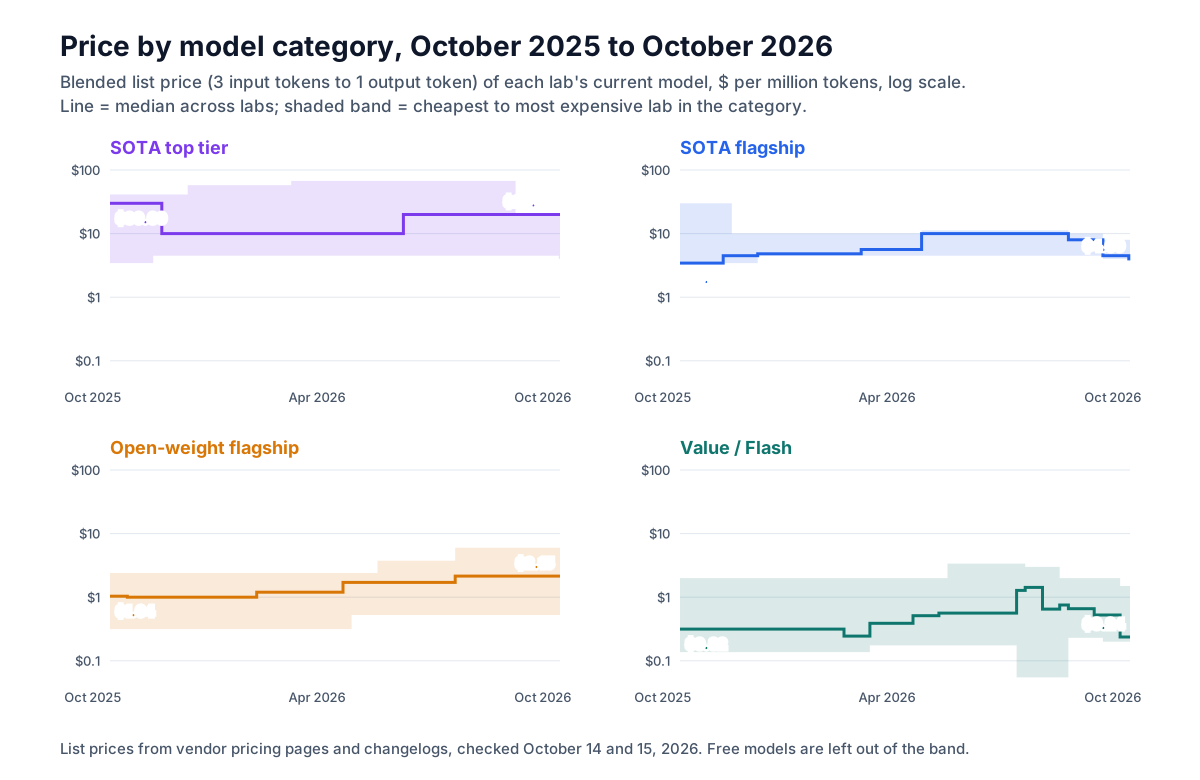
| Category | Models on Oct 15, 2026 | Median blended price, Oct 2025 | Median blended price, Oct 2026 | Input spread (highest ÷ lowest), Oct 2025 | Input spread, Oct 2026 |
|---|---|---|---|---|---|
| SOTA top tier | Claude Fable 5.1, GPT-6 Astra, Gemini 4 Argon | $30.00 | $20.00 | 12x | 5x |
| SOTA flagship | Claude Opus 5.5, GPT-6.1 Sol, Gemini 4 Argon | $3.44 | $4.00 | 12x | 2x |
| Open-weight flagship | GLM-5.3, Kimi K3, Qwen3.8 Max, DeepSeek V4 Pro, MiniMax M3 | $1.04 | $2.15 | 4.3x | 10x |
| Value / Flash | Haiku 5.5, GPT-6 Luna, Gemini 3.8 Flash, Gemini 3.5 Flash-Lite, DeepSeek V4.1 Flash, GLM-5.3 Flash, Qwen3.8 Flash | $0.32 | $0.24 | 20x | 7.5x |
- SOTA top tier: OpenAI’s pro models went from GPT-5 Pro at $15 / $120 to GPT-5.4 Pro at $30 / $180 before GPT-6 Astra reset the line at $10 / $50, the price of Claude Fable 5.1. Google prices Argon at $2 / $10 for now, which accounts for all of today’s 5x spread.
- Open-weight flagship: the median input price more than doubled, from $0.60 to $1.40, and prices diverged: Kimi K3 at $3 / $15 costs more than Claude Sonnet 5.5, while MiniMax M3 held at $0.30 / $1.20 across five releases. The open-weight median output price went from 24% to 44% of the closed flagship median. DeepSeek V4 Pro is counted at its peak price.
- Value / Flash: the median rose to $0.56 from May to July as low-cost models such as Gemini 3.1 Flash-Lite and Qwen3.6 Flash launched at $0.25 / $1.50, and fell mostly when Haiku 5.5 matched GPT-6 Luna’s $0.10 / $0.50 in October.
GPT-5.6 Terra is left out of the value category because it costs as much as a flagship. The data covers eight labs, not xAI or Mistral.
How much does a given capability level cost now?
The cheapest model at each index level got 2.5 to 50 times cheaper per token, and 8 to 19 times cheaper per task where both ends have per-task data. Per-task cost is Artificial Analysis’s cost of running one index task at list price with each model’s actual token count. For each day we took the cheapest current model scoring at least 20, 30, 40 or 50 on index version 4.3.2 at its highest reasoning setting.
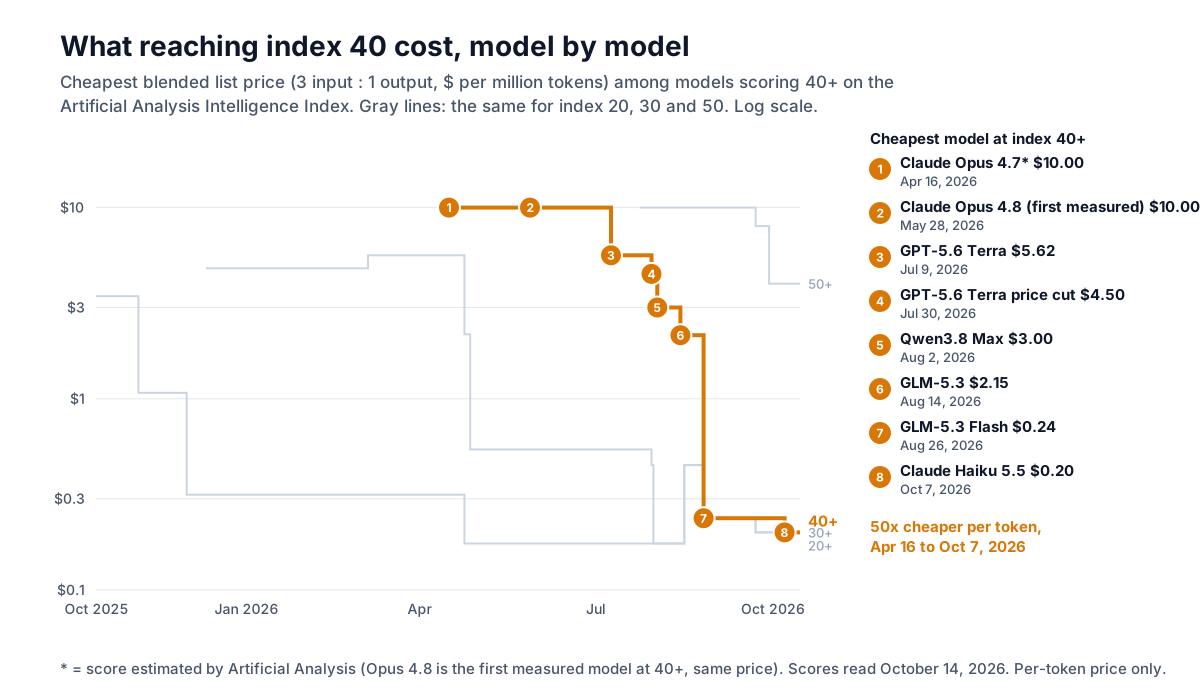
| Index level | Cheapest model when first reached between Oct 2025 and Oct 2026, blended $ per million tokens | Cheapest now | Times cheaper per token | Times cheaper per task |
|---|---|---|---|---|
| 20 | Start of window, Oct 2025: GPT-5*, $3.44 | Claude Haiku 5.5 or GPT-6 Luna, $0.20 | 17x | not published for GPT-5 |
| 30 | Dec 2025: GPT-5.2*, $4.81 | Claude Haiku 5.5 or GPT-6 Luna, $0.20 | 24x | not published for GPT-5.2 |
| 40 | Apr 2026: Claude Opus 4.7*, $10 | Claude Haiku 5.5, $0.20 | 50x | 19x, from Opus 4.8 (first with per-task data) $4.08 to Haiku 5.5 $0.21 |
| 50 | Jul 2026: Claude Opus 5, $10 | GPT-6.1 Sol or Gemini 4 Argon, $4 | 2.5x | 8.1x, from Opus 5 $5.86 to GPT-6.1 Sol $0.72 |
* Score estimated by Artificial Analysis rather than measured. The first measured model at index 40, Opus 4.8 in May, listed the same $10.
The cheapest price did not fall steadily: index 20 cost $0.175 on DeepSeek V4 Flash from late April to mid-August, below today’s $0.20.
The highest-scoring models did not become cheap. A year ago the top two were GPT-5 and Opus 4.1, with estimated scores of 23.0 and 22.8 at $3.44 and $30 blended. Today the top model is Claude Opus 5.5 at 57.6 for $8 blended. The large drops are at levels that only the best model reached a few months earlier.
Why did prices move this way?
Beyond what the labs said about their own prices, three market developments coincide with these moves and pull in different directions. They overlap in time, so the data cannot separate their effects.
Demand and serving capacity. When demand outgrows the GPUs available to answer requests, a provider can cap usage or charge more at busy times. OpenRouter, a marketplace that routes API requests to many model hosts, grew from about 5 trillion tokens a week in April 2025 to over 20 trillion in April 2026, with programming going from about 11% of its traffic to more than half (Wing VC). Anthropic lifted its busy-hour caps on Claude subscription use after it gained use of xAI’s Colossus 1 data center on May 6. The API price moves of the same period include GPT-5.5 at $5 / $30 in April, Google’s scheduled increases alongside its statement that it is “supply constrained”, and DeepSeek’s peak pricing.
Competition and the price floor. Chinese open-weight models rose from about 2% of OpenRouter tokens in late 2024 to about 61% by May 2026 (Wing VC), though first-party traffic such as ChatGPT’s is far larger than the router’s. In June the Wall Street Journal reported OpenAI weighing price cuts ahead of expected cuts from Anthropic (Decrypt), and both shipped cheaper models on September 22. The price floor, the cheapest price at a capability level, belonged to DeepSeek V4 Flash from late April until DeepSeek’s August increase, then moved to Claude Haiku 5.5 and GPT-6 Luna.
Revenue for open-weight labs. Open weights let any host sell the same model. After Zhipu released GLM-5.3 Flash, its own API’s share of that model’s OpenRouter traffic fell from 88% to 22% in three weeks, and Epoch AI, an AI research group, estimates DeepSeek receives about 8% of OpenRouter spending on DeepSeek models (Huxiu via Weijin Research). These figures postdate most of the open-weight price rise, so they are consistent with the rise but do not explain it. Hosts have not undercut the newest flagships much: on October 16 the lab’s own price was the most common one for GLM-5.3 (15 of 44 hosts) and Kimi K3 (7 of 25), and 12 of Kimi K3’s 15 cheaper hosts ran 4-bit quantized weights, a compressed version whose answers can differ from the original’s.
Why is price per token not price per task?
Two models with the same list price can differ severalfold in cost per task, mostly because of reasoning tokens: the hidden step-by-step reasoning a model writes before answering, billed as output. Artificial Analysis publishes each model’s average cost per index task at list price.
| Pair | List price, $ per million tokens (input / output) | Average cost per index task |
|---|---|---|
| Claude Haiku 5.5 vs GPT-6 Luna | both $0.10 / $0.50 | $0.21 vs $0.07 |
| Gemini 4 Argon vs GPT-6.1 Sol | both $2 / $10 | $1.99 vs $0.72 |
| Qwen3.8 Max vs GPT-6.1 Sol | $2 / $6 vs $2 / $10 | $5.41 vs $0.72 |
Qwen3.8 Max has the lower output price of its pair and costs 7.5 times as much per task. Our own test found Argon at 3.1 times GPT-6.1 Sol’s cost per correct answer (Gemini 4 Argon API cost). To compare models on your own traffic, price a batch of real requests from each response’s token counts (reasoning tokens are billed as output), divide the total by the number of acceptable answers, and compare models on that cost per answer.
How did cache prices change relative to input?
Cache reads (the cache hits described in the DeepSeek section) got cheaper relative to input on the closed labs’ flagship and top-tier models, and cache writes got more expensive at two vendors. The table gives each model’s cache-read price as a percentage of its own input price.
| Category | Cache read ÷ input, Oct 2025: median (range) | Oct 2026: median (range) | Lowest and highest today |
|---|---|---|---|
| SOTA top tier | 10% (every model) | 5% (2.5% to 10%) | Claude Fable 5.1 2.5%, GPT-6 Astra 10% |
| SOTA flagship | 10% (every model) | 5% (every model) | Claude Opus 5.5, GPT-6.1 Sol and Gemini 4 Argon all 5% |
| Open-weight flagship | 18% (10% to 25%) | 12.5% (3.3% to 20%) | DeepSeek V4 Pro 3.3%, MiniMax M3 20% |
| Value / Flash | 10% (every model) | 10% (2% to 20%) | DeepSeek V4.1 Flash 2%, GLM-5.3 Flash 20% |
The closed flagships halved their cache-read rate within three weeks: Opus 5.5 on September 22, GPT-6.1 Sol on September 29 and Argon on October 13. Open-weight labs charge a higher rate, with DeepSeek the exception, although V4 Pro’s 3.3% reflects a higher input price rather than a cheaper cache read. MiniMax went from 10% to 20% with M2.7 in March. Models that listed no cache price are left out.
Cache writes, the request that first stores a prefix, changed at two vendors. OpenAI began charging for them with GPT-5.6 in July: 1.25 times the input price for the default 30-minute cache and, from October 20, 2.5 times for a 12-hour cache. Kimi K3 still bills its default 5-minute write at the input price, as Kimi K2 did, but added an optional 1-hour cache at 2 times. Anthropic still charges 1.25 times for a 5-minute cache and 2 times for a 1-hour cache, and Google, DeepSeek and Zhipu still charge nothing extra. The cache write guide covers when a write pays off.
What should you do with this?
Budget by capability and by task rather than by tier name, and re-test the small tiers.
| Workload | What to check | Candidates and numbers |
|---|---|---|
| High-volume extraction, classification, routing | Whether a 2026 small model clears your quality bar | Claude Haiku 5.5 scores 43.4 and GPT-6 Luna 38.1 at $0.10 / $0.50; a year ago no model in the data scored above 23 |
| Agents and long reasoning | Cost per finished task | GPT-6.1 Sol $0.72 per index task, Gemini 4 Argon $1.99 at the same list price |
| Top-capability work | Whether you need index 50 or the very top | Index 50 costs $4 blended on GPT-6.1 Sol, or on Argon until December 1; Claude Opus 5.5 at 57.6 costs $8 |
| Budgeting on a launch price | How long the price will last | Google’s introductory prices have increases scheduled (Argon on December 1, Gemini 3.8 Flash on January 1); OpenAI cut all three GPT-5.6 launch prices within six weeks; Anthropic kept prices across releases and cut them with new models |
| Batch jobs on DeepSeek | Whether the work can run off-peak | DeepSeek V4.1 Flash costs half outside Beijing working hours: $0.15 / $0.60 against $0.30 / $1.20 |
| Open-weight flagships for cost | The exact model’s host prices and weight precision | 12 of the 15 hosts selling Kimi K3 below Moonshot’s price run 4-bit quantized weights |
FAQ
Are LLM API prices going down in 2026? LLM API prices per token mostly went up: the input list price rose on 10 of the 14 model tiers we compared between October 2025 and October 2026. Per unit of capability they fell: the cheapest model scoring 40 on the Artificial Analysis Intelligence Index cost $10 per million blended tokens in April 2026 and $0.20 in October (Claude Haiku 5.5), and per task it got 19 times cheaper from May to October.
Which AI lab cut API prices the most? Anthropic cut the most: over the two years to October 2026 it lowered list prices in all three of its tiers, with Claude Opus 5.5 at $4 / $20 against Claude 3 Opus’s $15 / $75 and Claude Haiku 5.5 at $0.10 / $0.50. Google raised all three of its tiers, and OpenAI’s flagship and small model ended within 25% of their October 2024 blended prices while its mid tier rose 17 times.
Related reading
- Gemini 4 Argon API cost: the same list price as GPT-6.1 Sol, 3.1x per correct answer
- Long-context pricing tiers: where each vendor’s price steps up with prompt length
- What a prompt cache write costs: write and read prices by vendor
- Claude Haiku 5.5 cost: the 100,000-token price line, measured
- Kimi K3 cost: an open-weight flagship at a closed model’s price