
Claude Haiku 5.5 Pricing: One Token Past 100K Costs 5x (Measured)

Contents
- How we measured
- What does Claude Haiku 5.5 cost on each side of the line?
- Do cached tokens and output count toward the 100,000 tokens?
- Is 100,000 tokens the same amount of text as on Claude Haiku 4.5?
- What happens when an agent’s context grows past the line?
- How do you keep an agent under the line?
- Is it cheaper than GPT-6 Luna at the same list price?
- FAQ
- How much does Claude Haiku 5.5 cost?
- Do cached tokens count toward Claude Haiku 5.5’s 100,000-token threshold?
- Is Claude Haiku 5.5 cheaper than Claude Haiku 4.5?
- Is Claude Haiku 5.5 cheaper than GPT-6 Luna?
- How do I keep Claude Haiku 5.5 requests under 100,000 tokens?
- Related reading
Claude Haiku 5.5 has two price lists, and the length of the prompt picks one for the whole request. We sent a prompt of exactly 100,000 tokens and it billed $0.0100. The same prompt with one more token billed $0.0500. The prompt is everything you send: system prompt, tool definitions and messages. It also includes the tokens read from the prompt cache, which Anthropic’s price list does not spell out and which we confirmed against Anthropic’s own bill.
TL;DR
- A 100,000-token prompt on Claude Haiku 5.5 billed $0.010008. A 100,001-token prompt billed $0.050041, five times as much.
- A 102,011-token prompt that was 94% cache reads billed at the higher prices: $0.0078, against $0.0016 at the lower ones.
- The same English text is 1.4 to 1.5 times as many tokens on Haiku 5.5 as on Claude Haiku 4.5.
- In an agent loop, six requests past the line were 76% of an $0.083 run. Compaction or a sub-agent cut it to $0.026 or $0.016.
How we measured
Most requests went through the Synthorai gateway on October 8 and 9, 2026, and “billed” means what the gateway charged for a request. It applies Anthropic’s two price lists and takes the prompt length as the sum of the three input counts in the response: uncached input, cache reads and cache writes. All 581 billed amounts we checked matched one of the two lists to six decimal places.
Anthropic’s pricing page says only that the model is “priced by prompt length”, and the API response carries no price. So we also sent 23 of the same prompts straight to the Anthropic API and read the day’s cost for the model in the Anthropic Console: $0.33. Those requests add up to $0.3301 if every prompt over 100,000 tokens pays the higher list, cached or not, and to $0.2678 if cache reads do not count. Anthropic bills the way the gateway does.
What does Claude Haiku 5.5 cost on each side of the line?
Five times as much on every row of the price list once the prompt is over 100,000 tokens. Prices are per million tokens.
| Prompt up to 100,000 tokens | Prompt over 100,000 tokens | Claude Haiku 4.5 | |
|---|---|---|---|
| Input | $0.10 | $0.50 | $1.00 |
| Output | $0.50 | $2.50 | $5.00 |
| Cache read | $0.01 | $0.05 | $0.10 |
| Cache write, 5 minutes | $0.125 | $0.625 | $1.25 |
| Batch input / output | $0.05 / $0.25 | $0.25 / $1.25 | $0.50 / $2.50 |
A cache write is the first request that stores a prompt prefix, and a cache read is a later request that reuses it. Batch is Anthropic’s asynchronous API at half price.
The higher list applies to the whole request and is not a surcharge on the tokens past the line. We built a prompt of 99,872 tokens and padded it a token or two at a time:
| Prompt tokens | Billed | Price list |
|---|---|---|
| 99,998 | $0.010008 | lower |
| 100,000 | $0.010008 | lower |
| 100,001 | $0.050041 | higher |
| 100,002 | $0.050041 | higher |
Exactly 100,000 tokens is still on the lower list, as the wording “over 100,000” says. Anthropic says prompts of up to 100,000 tokens were about 90% of requests to Claude Haiku 4.5; per token, the new model is 90% cheaper than the old one below the line and 50% cheaper above it.
Do cached tokens and output count toward the 100,000 tokens?
Cached tokens count and output does not. We cached a 96,045-token prefix, then sent it again with tails of different lengths:
| Request | Prompt tokens | Read from cache | Billed | Price list |
|---|---|---|---|---|
| prefix, first time (written to cache) | 96,058 | 0 | $0.012009 | lower |
| prefix again | 96,058 | 96,045 | $0.000964 | lower |
| prefix and a 1,000-token tail | 97,034 | 96,045 | $0.001061 | lower |
| prefix and a 6,000-token tail | 102,011 | 96,045 | $0.007795 | higher |
The last request is 94% cache reads and pays the higher list: $0.0078, where the lower list would have been $0.0016. For output, a 97,864-token prompt with a 1,905-token reply billed $0.010739, the lower list.
The number to compare with the line is the sum of three fields of the response. To know before sending, the token counting endpoint takes the same system, tools and messages as the request:
import anthropic

client = anthropic.Anthropic()

# after a request: the length the price list is chosen by
u = response.usage
prompt_tokens = u.input_tokens + u.cache_read_input_tokens + u.cache_creation_input_tokens

# before a request
count = client.messages.count_tokens(model="claude-haiku-5-5", system=system, tools=tools, messages=messages)
over_the_line = count.input_tokens > 100_000
Is 100,000 tokens the same amount of text as on Claude Haiku 4.5?
No. Claude Haiku 5.5 uses a newer tokenizer, the step that splits text into the units a model is billed by, and the same text comes out as more tokens than on Claude Haiku 4.5. Anthropic’s migration guide says “approximately 30% more”. We counted five samples on both models:
| Text | Haiku 4.5 | Haiku 5.5 | Ratio | 100,000 on Haiku 5.5 is, on Haiku 4.5 |
|---|---|---|---|---|
| English prose (a NIST report, 12 pages) | 6,478 | 9,618 | 1.48 | 67,353 |
| A research paper, 6 pages | 4,352 | 6,048 | 1.39 | 71,958 |
| JavaScript source | 8,802 | 11,814 | 1.34 | 74,505 |
| Python source | 9,743 | 12,144 | 1.25 | 80,229 |
| Markdown, Chinese and English mixed | 13,351 | 14,710 | 1.10 | 90,761 |
English prose that was 68,000 tokens on Haiku 4.5 is already at the line on Haiku 5.5, so a budget measured on the old model puts the line in the wrong place. The saving per document is also smaller than the saving per token: at 1.48 times the tokens, English prose costs 85% less than on Haiku 4.5 below the line and 26% less above it.
What happens when an agent’s context grows past the line?
The request that crosses costs about five times the one before it, and every later request stays at that level. An agent loop sends the whole conversation again on each turn, so a prompt that grows by one tool result per turn reaches 100,000 tokens eventually.
We ran an agent on Claude Haiku 5.5 that reads 20 log files of about 7,000 tokens each with a read_file tool and reports a total across them. Every tool result stays in the conversation and the prefix is cached, which is how such loops are usually built. Requests 15 to 18 of one run:
| Request | Prompt tokens | Read from cache | Billed |
|---|---|---|---|
| 15 | 92,701 | 85,593 | $0.001787 |
| 16 | 99,705 | 92,699 | $0.001845 |
| 17 | 106,744 | 99,703 | $0.009598 |
| 18 | 113,771 | 106,742 | $0.009942 |
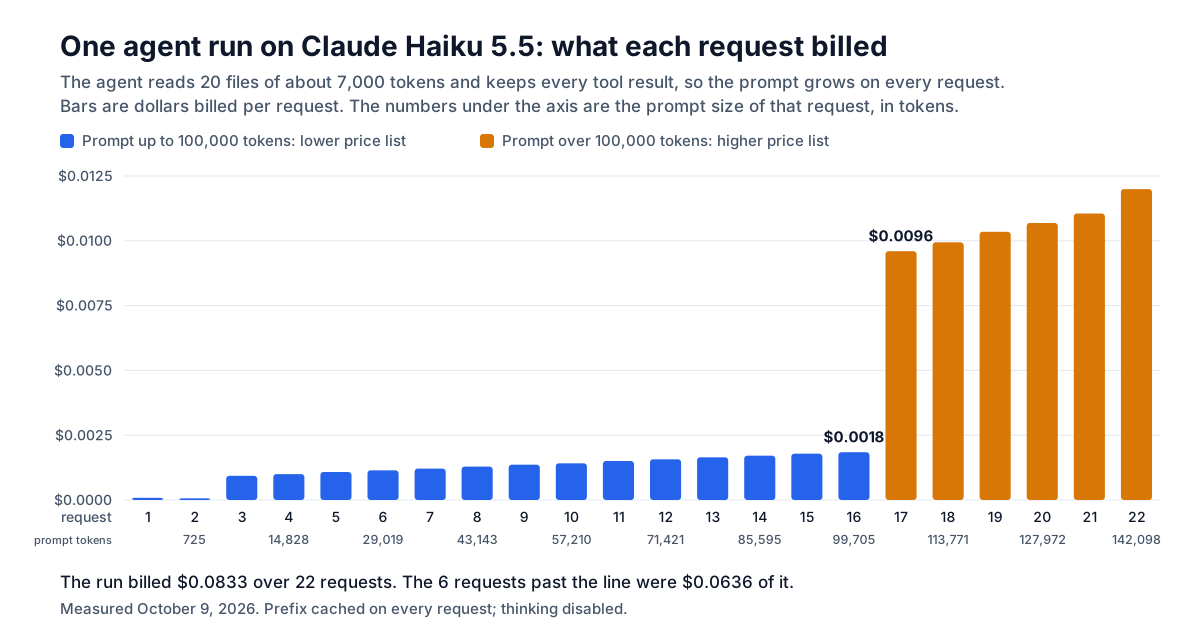
Request 17 is 7,000 tokens longer than request 16 and costs 5.2 times as much. The run made 22 requests and billed $0.0833, of which the six requests past the line were $0.0636, or 76%. The same tokens at the lower prices would have been $0.0324.
How do you keep an agent under the line?
Stop old tool results from accumulating in the main conversation. We ran the same task four ways on Claude Haiku 5.5, five runs each, every run starting with an empty cache:
| Approach | Right total | Billed per run (median) | Requests | Largest prompt |
|---|---|---|---|---|
| Keep everything | 5 of 5 | $0.0823 | 22 | 142,119 |
| Compact at 80,000 tokens | 5 of 5 | $0.0261 | 23 | 92,829 |
| Trim old tool results | 3 of 5 | $0.0228 | 22 | 10,278 |
| A sub-agent reads each file | 5 of 5 | $0.0156 | 42 | 7,100 |
- Compaction. When the prompt passes 80,000 tokens, one extra request asks the model for a progress note and the conversation restarts from it. Leave room in the threshold: the next tool result has to fit under 100,000 as well.
- Trimming. Before each request, every tool result except the newest becomes a one-line stub. Two of five runs returned a wrong total after an arithmetic slip in the running total the model kept in its replies. Five runs cannot show that trimming is less reliable (3 of 5 against 5 of 5 is not a significant difference), but they show the risk: once the source is trimmed away, a slip cannot be corrected.
- Sub-agent. The main agent’s tool hands each file to a separate request that returns one line. This was the cheapest, made the most requests and took about a quarter longer. The separate request sees only what it is given, so its instruction has to say what to look for as precisely as the main agent’s does.
All four ran with thinking disabled. Thinking is the model’s hidden working before it answers, on by default for this model. Anthropic’s migration guide says a request that sends thinking blocks back after an earlier message has changed returns a 400 error (on accounts created before August 31, 2026, only if they opt in to the check), so trimming needs thinking off or the thinking blocks left out. Compaction and sub-agents start a fresh conversation and avoid the problem.
Is it cheaper than GPT-6 Luna at the same list price?
No in our runs: at equal accuracy it cost about twice as much. GPT-6 Luna lists at the same $0.10 and $0.50, with no change at any prompt length.
Anthropic’s own numbers put Claude Haiku 5.5 ahead of GPT-6 Luna on agent benchmarks and far ahead of Claude Haiku 4.5:
| Benchmark (Anthropic’s announcement) | What it tests | Haiku 5.5 | GPT-6 Luna | Haiku 4.5 |
|---|---|---|---|---|
| GDPval-AA v2.1 | knowledge-work tasks, Elo score | 1620 | 1437 | 735 |
| OSWorld 2.1, offline subset | operating a computer | 72.4% | 48.9% | 15.7% |
| Terminal-Bench 4.0 | coding tasks in a terminal | 39.2% | 16.4% | 0.0% |
We ran the three models at their default settings, and Haiku 5.5 also with thinking off, on two smaller sets with checkable answers: 96 classification, extraction and tool-routing items, the work Anthropic names for this model, and 14 multi-step tasks run three times each.
| Model | Short items right, of 96 | Cost per 1,000 calls | Multi-step right, of 42 | Cost per correct answer |
|---|---|---|---|---|
| Claude Haiku 5.5 | 95 | $0.107 | 39 | $0.00103 |
| Claude Haiku 5.5, thinking off | 94 | $0.069 | 33 | $0.00036 |
| GPT-6 Luna | 95 | $0.049 | 38 | $0.00043 |
| Claude Haiku 4.5, no extended thinking | 94 | $0.679 | 10 | $0.01053 |
Cost per correct answer is total spend divided by the number of right answers. Accuracy is level between Haiku 5.5 and GPT-6 Luna on both sets (39 and 38 of 42 are the same result), and Haiku 5.5 costs a little over twice as much. On the short items it counted 482 input tokens where GPT-6 Luna counted 231, and on the multi-step tasks it wrote 1,902 output tokens per call against 759. Against Haiku 4.5, which ran at its default of no extended thinking, it costs 84% less on the short items and gets about four times as many multi-step tasks right.
Thinking runs at medium effort by default; effort is the setting for how much the model thinks, from low to max, and thinking: {"type": "disabled"} turns it off. With thinking off the short items scored the same at two thirds of the cost, but the multi-step tasks lost 6 of 42 answers, and the model wrote its working into every reply where one number was asked for. max effort scored the same 39 as the default at twice the cost.
Where that leaves the model: it is the cheap tier of the Claude line and a large step up from Haiku 4.5 at a tenth of the token price. For short, high-volume calls GPT-6 Luna did the same work for half the money in our runs. Haiku 5.5’s case is agent work, where Anthropic’s benchmarks put it well ahead and we did not compare the two, as long as the prompt stays under 100,000 tokens. Before moving a Haiku 4.5 workload, recount its prompts on the new model, and remove what Haiku 5.5 rejects with a 400 error according to the migration guide: a manual thinking budget, a non-default temperature, top_p or top_k, and a prefilled assistant turn.
FAQ
How much does Claude Haiku 5.5 cost?
For prompts of up to 100,000 tokens, Claude Haiku 5.5 costs $0.10 per million input tokens and $0.50 per million output tokens. For prompts over 100,000 tokens it costs $0.50 and $2.50, applied to the whole request. Cache reads are $0.01 and $0.05, and the Batch API halves input and output on both lists.
Do cached tokens count toward Claude Haiku 5.5’s 100,000-token threshold?
Yes. A 102,011-token prompt to Claude Haiku 5.5, of which 96,045 tokens were read from cache, billed at the higher prices: $0.0078, against $0.0016 at the lower ones. The prompt length is uncached input plus cache reads plus cache writes. Anthropic’s price list does not say so, but ten such requests sent directly to its API were charged at the higher prices on our Anthropic bill. Output tokens do not count.
Is Claude Haiku 5.5 cheaper than Claude Haiku 4.5?
Yes on both sides of the line, by less than the price list suggests, because the same text is more tokens on the new model. For English prose we measured 1.48 times the tokens, which makes Claude Haiku 5.5 about 85% cheaper than Claude Haiku 4.5 below 100,000 tokens and about 26% cheaper above.
Is Claude Haiku 5.5 cheaper than GPT-6 Luna?
Not in our runs, though the list prices are the same. On 96 short tasks Claude Haiku 5.5 cost $0.107 per 1,000 calls at its default and GPT-6 Luna $0.049, with the same accuracy. Haiku 5.5 counted about twice the input tokens for the same items and wrote more output.
How do I keep Claude Haiku 5.5 requests under 100,000 tokens?
Count tokens before sending, and in agent loops stop old tool results from accumulating. Summarize the conversation into a note before it reaches the line, or have a separate request read each large input and return only the result. In our test with Claude Haiku 5.5 these cut an $0.082 task to $0.026 and $0.016, with the right answer in every run.
Related reading
- Long-context pricing tiers: the other models that change price with prompt length.
- Claude Sonnet 5.5 vs Sonnet 5: effort and cost per task one tier up.
- GPT-6 Luna: what the reasoning dial costs: the model at the same list price.
- Claude Sonnet 5’s tokenizer: the tokenizer Haiku 5.5 now shares.