
Gemini 4 Argon Cost: Same Price as GPT-6.1 Sol, 3x per Correct Answer
Contents
- What does Gemini 4 Argon cost?
- Which OpenAI and Claude models does Gemini 4 Argon compete with?
- How does Argon’s cost per answer compare with GPT-6.1 Sol, GPT-6 Astra and Opus 5.5?
- What does each thinking level do?
- What breaks when you migrate to Gemini 4 Argon?
- Which thinking level should you use for which workload?
- FAQ
- Related reading
Gemini 4 Argon charges the same $2 per million input tokens and $10 per million output tokens as GPT-6.1 Sol, but on our 13-task reasoning set it cost 3.1x as much per correct answer ($0.0063 vs $0.0020, total spend divided by correct answers), because it wrote 3.3x as many output tokens for the same score, 38 of 39 calls correct. Against the top-tier models Google benchmarks it on, the order flips: Argon cost 0.76x Claude Opus 5.5’s and 0.6x GPT-6 Astra’s, until its price doubles on December 1. The main cost control is thinking_level, a request parameter that sets how long gemini-4-argon reasons before answering (low, medium by default, high); reasoning tokens bill as output even when the reply hides them. We measured all three levels two days after the API launched, with the comparison models and Gemini 3.1 Pro run the same day.
TL;DR
- Gemini 4 Argon costs $2/$10 per million tokens through November 30, 2026, then $4/$20.
- Google benchmarks Argon against GPT-6 Astra, Claude Fable 5.1 and Claude Opus 5.5; Argon leads 13 of the 19 rows published.
- At
medium, Argon cost $0.0063 per correct answer, GPT-6.1 Sol $0.0020, Opus 5.5 $0.0083; at December prices Argon is $0.0125. - Argon’s
lowlevel reported no reasoning and got 1 of 15 calls on the five hardest tasks right, compared with 14 of 15 atmedium.
What does Gemini 4 Argon cost?
Gemini 4 Argon’s API price doubles on December 1, 2026. Google’s pricing page lists one rate through November 30 and the list price after that, with no free tier. Cached input is text the server already saw in an earlier request, such as a repeated system prompt, and it bills at 5% of the input price. Prices are in dollars per million tokens:
| Tier | Input | Output (thinking included) | Cached input |
|---|---|---|---|
| Standard, through Nov 30 | $2.00 | $10.00 | $0.10 |
| Standard, from Dec 1 | $4.00 | $20.00 | $0.20 |
| Batch and Flex, through Nov 30 | $1.00 | $5.00 | $0.05 |
| Priority, through Nov 30 | $3.60 | $18.00 | $0.18 |
Batch (submitted as a job, results within hours) and Flex (best-effort capacity) stay at half the standard rate after December 1, and Priority (reserved capacity) at 1.8x. Three things differ from Gemini 3.1 Pro, Google’s previous top model at $2/$12:
- No long-context surcharge. Gemini 3.1 Pro charges $4/$18 once a prompt passes 200K tokens; Argon keeps $2/$10 up to its 1,048,576-token context window, the most tokens one request can hold across input, thinking and reply. At list price, our 709K-token prompt cost $1.42 on Argon and $2.84 on 3.1 Pro.
- Implicit caching only. Explicit caching, where you created a cache object and paid for its storage, is gone. Repeated prompt prefixes are cached automatically at the cached-input rate.
- Output past 64K needs a different mode. A normal request returns at most 65,536 output tokens; longer outputs need Google’s background execution mode, where the server keeps generating in 64K steps up to 1M tokens.
Which OpenAI and Claude models does Gemini 4 Argon compete with?
On capability, Google pitches Gemini 4 Argon against each lab’s top model: GPT-6 Astra, Claude Fable 5.1 and Claude Opus 5.5. On price it sits one tier lower, at GPT-6.1 Sol’s $2/$10 until November 30 and at Opus 5.5’s $4/$20 from December 1. GPT-6 Astra and Fable 5.1 list at $10/$50.
The Artificial Analysis Intelligence Index combines agent, coding, knowledge and science benchmarks that Artificial Analysis runs itself, and it also reports what running one task of the index costs on each model. On it, Argon is level with GPT-6 Astra and Fable 5.1, and Opus 5.5 leads by four to five points:
| Model | List price, $ per million tokens | In Google’s benchmark table | Index score (at the vendor’s highest setting) | Cost per index task |
|---|---|---|---|---|
| Gemini 4 Argon | 2/10, then 4/20 | The subject | 52.6 | $1.99 |
| GPT-6 Astra | 10/50 | Yes | 52.7 | $3.26 |
| Claude Fable 5.1 | 10/50 | Yes | 53.4 | $7.63 |
| Claude Opus 5.5 | 4/20 | Yes | 57.6 | $5.98 |
| GPT-6.1 Sol | 2/10 | No | 51.8 | $0.72 |
Google’s own table, from the Argon model card, has 19 rows. Argon leads 13 and ties one; GPT-6 Astra leads three and Opus 5.5 two. Ten of the 19 rows are below: the widest gaps, which are in knowledge work and long context, and all five rows Argon loses, which are hours-long coding, terminal work and desktop computer use. Scores are percentages, higher is better:
| Benchmark | What it tests | Argon | GPT-6 Astra | Fable 5.1 | Opus 5.5 |
|---|---|---|---|---|---|
| Vals Index | Vals AI’s knowledge-work composite | 68.9% | 63.1% | 65.8% | 67.0% |
| Harvey Legal Agent | Legal tasks done end to end by the model | 19.6% | 5.4% | 6.7% | 3.8% |
| DeepSWE v1.1 | Fixing issues in real repositories | 77.9% | 74.1% | 67.4% | 74.2% |
| FrontierSWE v2 | Hours-long engineering and optimization tasks | 55.0% | 65.5% | 56.3% | 62.3% |
| Terminal-Bench 4.0 | Tasks in a Linux terminal | 57.4% | 58.2% | 57.9% | 66.4% |
| PostTrainBench | Training a model on one GPU in 10 hours | 45.3% | 44.3% | 40.2% | 49.3% |
| Terminal-Bench Science 0.1 | Scientific computing in a terminal | 57.6% | 68.1% | 52.6% | 63.3% |
| RiemannBench | Research-level math problems | 76.0% | 72.0% | 65.6% | 69.6% |
| GraphWalks, 256K to 1M | Following links through a long-context graph | 84.2% | 71.8% | 65.0% | 66.8% |
| OSWorld 2.0, offline | Desktop computer use | 69.2% | 72.6% | not reported | not reported |
Read the table as Google’s claim rather than a controlled comparison. Per Google’s methodology note, Argon ran at its highest thinking setting, and most competitor numbers come from the vendors’ own evaluation reports or public leaderboards at their maximum or best available reasoning setting. Several Argon scores (DeepSWE, both Terminal-Bench rows, OSWorld) were produced by Google with its own test harness, the code that runs and grades the tasks, while the competitors’ came from elsewhere; on Terminal-Bench Science the grading program was allowed six times longer for Argon.
How does Argon’s cost per answer compare with GPT-6.1 Sol, GPT-6 Astra and Opus 5.5?
At the same per-token price, Gemini 4 Argon cost 3.1x as much per correct answer as GPT-6.1 Sol at medium, the default level for both, and 7.7x as much at high. Both scored 38/39 at medium. Against the top models it is cheaper for now: 0.6x GPT-6 Astra’s cost per correct answer and 0.76x Claude Opus 5.5’s.
We ran 13 reasoning tasks whose answers a short program had verified, three runs of each, so every model and level below has 39 calls. A call counts as correct when its final integer matches. The eight easier tasks: summing the primes below 60, counting the digit 7 from 1 to 500, a train timetable, 7 to the power 222 modulo 1000, a rule applied 40 times in a row, four-digit numbers with distinct nonzero digits divisible by 11, grid paths around one blocked cell, and ways to make 47 cents. The five hardest, which we call the hard set: the same rule applied 200 times, the remainder of 13 to the power 1001 divided by 10007, an 8x8 grid with three blocked cells, choosing which of 10 items fit under a weight limit, and 187 cents with five coin types.
Each model was driven through the request format that carries its thinking control: Argon and Gemini 3.1 Pro through OpenAI’s older chat format, which many providers copy and where the control is reasoning_effort; the GPT models through OpenAI’s newer Responses format; Opus 5.5 through Anthropic’s own, where the control is output_config.effort. We used each vendor’s medium and high, plus low where the model has it.
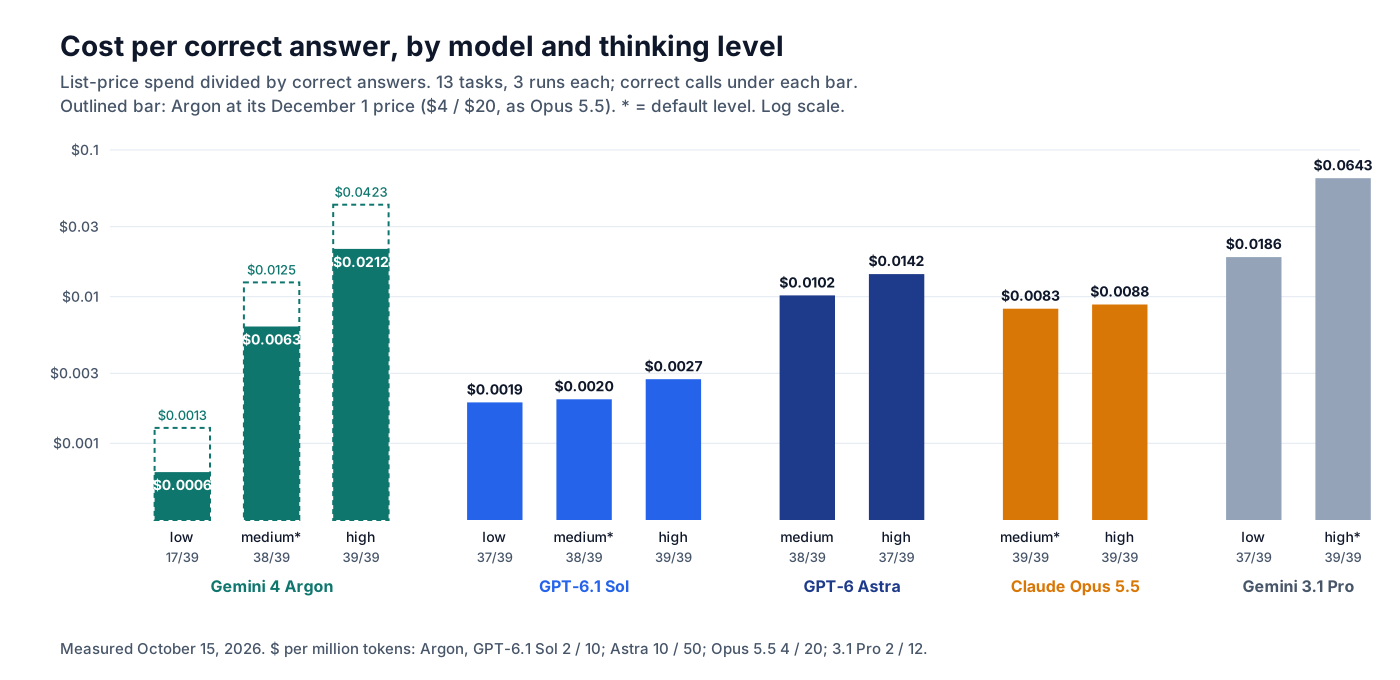
| Model and level | Correct calls (of 24 easy / of 15 hard) | Median output tokens (thinking included) | Cost per correct answer | At Argon’s December price |
|---|---|---|---|---|
Argon low | 16/24, 1/15 | 7 | $0.0006 | $0.0013 |
Argon medium (default) | 24/24, 14/15 | 383 | $0.0063 | $0.0125 |
Argon high | 24/24, 15/15 | 1,455 | $0.0212 | $0.0423 |
GPT-6.1 Sol low | 24/24, 13/15 | 90 | $0.0019 | |
GPT-6.1 Sol medium (default) | 24/24, 14/15 | 81 | $0.0020 | |
GPT-6.1 Sol high | 24/24, 15/15 | 192 | $0.0027 | |
GPT-6 Astra medium (default) | 24/24, 14/15 | 90 | $0.0102 | |
GPT-6 Astra high | 24/24, 13/15 | 134 | $0.0142 | |
Claude Opus 5.5 medium (default) | 24/24, 15/15 | 188 | $0.0083 | |
Claude Opus 5.5 high | 24/24, 15/15 | 223 | $0.0088 | |
Gemini 3.1 Pro low | 24/24, 13/15 | 1,091 | $0.0186 | |
Gemini 3.1 Pro high (default) | 24/24, 15/15 | 3,272 | $0.0643 |
The gap with GPT-6.1 Sol comes from output length. Across all 39 calls at medium, Argon wrote 22,980 output tokens in total and GPT-6.1 Sol wrote 7,032. On the hardest single task, 13 to the power 1001 modulo 10007, Argon’s median was 1,523 tokens at medium and 6,108 at high; GPT-6.1 Sol’s were 524 and 901. The scores on the hard set were the same: 14/15 each at medium and 15/15 each at high. From December 1 the medium gap doubles to 6.3x, because Argon’s price doubles and GPT-6.1 Sol’s does not.
December also changes the comparison with Opus 5.5. Both will list at $4/$20, and on our set Opus 5.5 wrote fewer tokens (15,414 to Argon’s 22,980 at medium) and answered all 39 correctly. At the December price Argon costs $0.0125 per correct answer to Opus 5.5’s $0.0083, 1.5x as much; relative to GPT-6 Astra it moves from 0.6x to 1.2x. With 15 hard-set calls per level, none of the score differences among Argon, Opus 5.5 and GPT-6 Astra is statistically distinguishable (these pairs were checked separately from the corrected family in the next section). Artificial Analysis’s per-task costs rank the models the same way: GPT-6.1 Sol $0.72 at its top setting, Argon $1.99 at high and the current price, GPT-6 Astra $3.26, Opus 5.5 $5.98.
Compared with Gemini 3.1 Pro, the model Argon replaces, Argon is about 10x cheaper per correct answer at each model’s default level: $0.0063 to $0.0643. Part of that is price, since 3.1 Pro charges $12 per million output tokens instead of $10; at equal prices the gap is 8.6x and comes from 3.1 Pro’s median 3,272 output tokens per call to Argon’s 383. After December 1 Argon is still 5.1x cheaper on this set. We also checked how many tokens each model spends admitting it does not know a made-up fact: asked about five invented entities (a company’s share price, a research institute, a town charter, an alloy and a prize), both declined all five, Argon in a median 146 output tokens and 3.1 Pro in 1,014.
What does each thinking level do?
On Gemini 4 Argon, low was effectively thinking turned off. Google documents three levels and describes low as using the “fewest tokens”, adding that “quality can drop on hard tasks”. In all 39 calls at low, Argon reported no reasoning tokens, and its entire output, which on this route includes any reasoning, was 5 to 11 tokens. A second API route that forwards to Google’s servers reported 0 reasoning tokens explicitly on all four low calls we sent. Gemini 3.1 Pro’s low, by contrast, still wrote a median 1,091 output tokens, nearly all of it reasoning.
Without reasoning, Argon still solved the one-step tasks and failed the ones that need intermediate steps:
- Still correct at
low: the prime sum, the digit count, the timetable, the one-cell grid and 47 cents (15 of 15 calls). - Wrong at
low: the 40-step rule (0/3), the four-digit count (0/3), 7 to the power 222 (1/3), and 14 of 15 calls on the hard set.
The drop holds when each task counts once, which matters because three runs of the same task are not independent: medium beat low on 8 of the 13 tasks and lost on none (sign test, p = 0.008, under a 1% chance that a gap this large is luck). On the hard set alone, low solved none of the five tasks in at least two of three runs and medium solved all five (Fisher’s exact test, p = 0.008; 0.047 after the Holm correction for the six comparisons we ran). Treat low as a no-thinking mode for lookups and format conversion. At the other end, high cost 3.4x as much per correct answer as medium and got one more hard-set call right out of 15, a difference this sample cannot separate from chance.
The default adapts to the prompt. On simple prompts sent without any level, Argon, whose default is medium, often used zero reasoning tokens, while Gemini 3.1 Pro, whose default is high, reasoned on every one of them. Tool calling is where the model asks your code to run a function and you send back the result:
| Prompt type (median of 3 runs) | Argon reasoning tokens | Gemini 3.1 Pro reasoning tokens |
|---|---|---|
| One-word lookup | 0 | 145 |
| JSON extraction | 0 | 353 |
| Strict JSON schema output | 0 | 309 |
| Two-step word problem | 41 | 137 |
| Five-step arithmetic chain | 68 | 373 |
| Tool-calling loop, first turn (pick a tool) | 0 (31 output tokens) | 173 |
| Tool-calling loop, second turn (use the result) | 0 (32 output tokens) | 67 |
Both models answered every prompt correctly and called the right tools. On Google’s native API the level goes in generation_config and the reasoning count comes back in usage:
from google import genai

client = genai.Client()
interaction = client.interactions.create(
    model="gemini-4-argon",
    input="Compute 13 raised to the power 1001, modulo 10007. Reply with a single integer.",
    generation_config={"thinking_level": "medium", "max_output_tokens": 32768},
)
print(interaction.output_text)
print("thinking tokens:", interaction.usage.total_thought_tokens)  # billed at the output rate
print("output tokens:", interaction.usage.total_output_tokens)
On the OpenAI-compatible chat format we measured through, the gateway maps reasoning_effort to the same three levels, and the count comes back in usage.completion_tokens_details.reasoning_tokens.
What breaks when you migrate to Gemini 4 Argon?
Prompts that end with a prefilled assistant turn now fail with HTTP 400, explicit caching is gone, and the randomness settings (temperature, top_p, top_k) are ignored. Prefilling means starting the model’s reply yourself, for example with an opening brace to force JSON. Most of these are in Google’s migration checklist; the prefill error, the prompt overhead and the overflow behavior are not:
| Change | Google’s docs | What we measured |
|---|---|---|
| Prefilled assistant turn | Not listed | HTTP 400 on Gemini 4 Argon: “Requests ending with a model turn are not supported”; Gemini 3.1 Pro accepts it |
Explicit caching (cachedContents) | Removed | Not tested; implicit caching worked |
| Implicit cache | 95% off, prompts of 4,096+ tokens | A repeated 6,935-token prompt had 4,881 tokens served from cache 4 seconds later, priced at $0.10 per million; a 3,006-token prompt also got 952 cached tokens |
temperature, top_p, top_k | Ignored | Accepted with HTTP 200 (no error) |
| Fixed prompt overhead | Not listed | About 30 more input tokens per request than Gemini 3.1 Pro for identical text; a second API route to Google reports the same count |
| Prompt over the 1M window | Not listed | HTTP 400 that names the limit, no silent truncation |
max_output_tokens | Raise to 32,768 or more | Argon’s longest answer was 6,391 tokens at high, Gemini 3.1 Pro’s 21,362 |
For the prefill error, move the instruction into the prompt. The overhead adds $0.00006 per request at the current price and is constant: 27 extra tokens on a one-line prompt and 31 on a 709K-token document relative to Gemini 3.1 Pro, so the tokenizer, the step that splits text into tokens, has not changed. That 709K-token prompt was 60,000 numbered items with a question about item 42 at the end; Argon was accepted and answered 529, the planted value.
Which thinking level should you use for which workload?
Start at medium, never use low for multi-step work, and budget for the December price.
| Workload | Main risk | Level and model | Supporting numbers |
|---|---|---|---|
| Agent steps, tool calls, extraction, JSON output | Paying for thinking on easy steps | Gemini 4 Argon medium; it already spends almost nothing on thinking here | 0 reasoning tokens on lookup, extraction, schema output and tool steps |
| Hard math, algorithms, multi-step code | Wrong answers | Argon medium; test high on your own evals before paying for it | 14/15 vs 15/15 hard-set calls, high at 3.4x the cost |
| High-volume reasoning where cost per answer rules | Thinking volume | GPT-6.1 Sol, same score on this 13-task set | $0.0020 vs $0.0063 per correct answer, 6.3x after December 1 |
| Top-tier work budgeted past December | Argon’s price doubling | Re-run your evals on Claude Opus 5.5, same $4/$20 list | $0.0083 vs $0.0125 per correct answer at December prices; Argon leads more of Google’s knowledge-work rows |
| Long documents over 200K tokens | Long-context surcharge | Argon instead of Gemini 3.1 Pro | $1.42 vs $2.84 for a 709K-token prompt |
| Lookups and format conversion only | Unnecessary reasoning | Argon low | 15/15 on one-step tasks, 7 output tokens |
After December 1, Batch and Flex cost what standard costs now ($2/$10), so moving offline jobs there keeps you at October’s prices.
FAQ
Can you turn off thinking on Gemini 4 Argon?
Gemini 4 Argon has no documented off setting, but thinking_level: "low" worked as an off switch in our tests: no reasoning tokens reported on any of 39 calls, whose whole output was 5 to 11 tokens, and an explicit 0 on all four calls through a second API route to Google. At low it answered 1 of 15 calls on the five hardest tasks correctly, compared with 14 of 15 at the default medium.
Does Gemini 4 Argon charge more for long prompts? Gemini 4 Argon charges the same $2/$10 rate for any prompt up to its 1,048,576-token window through November 30, 2026, and $4/$20 after. Gemini 3.1 Pro charges $4/$18 above 200K tokens, so at list price a 709K-token prompt costs $1.42 on Argon and $2.84 on 3.1 Pro.
Does implicit caching work on Gemini 4 Argon? Implicit caching on Gemini 4 Argon served 4,881 of a repeated 6,935-token prompt from cache 4 seconds after the first call, priced at $0.10 per million tokens (95% off input). It also cached part of a 3,006-token prompt, below the 4,096-token minimum in Google’s docs.
Related reading
- GPT-6.1 Sol vs Claude Sonnet 5.5: the same 13-task set at the same $2/$10 price
- LLM thinking controls compared: what each vendor’s effort parameter does
- Prompt cache minimums, measured: documented versus actual cache floors
- Gemini 3.7 Flash API cost: the previous Gemini intro-pricing launch
Measured October 15, 2026, two days after API general availability. Thinking levels: 13 tasks with program-verified answers, 3 runs per model and level, significance tested with each task counted once, each prompt tagged with a random ID so no response could be served from a cache; costs computed at list price from the token counts. Thinking-tax, structured-output and tool probes: 3 runs each; migration, cache, long-context and made-up-fact probes: single calls. The low result and the prompt-token overhead were confirmed through a second API route that forwards to Google. Artificial Analysis figures read October 14, 2026; Google’s benchmark table from the Gemini 4 Argon model card.