
GPT-4 and GPT-3.5 Turbo Shut Down Oct 23: 3.5's Swap Costs About 5x
Contents
OpenAI shuts down GPT-4, GPT-4 Turbo, GPT-3.5 Turbo, GPT-4.1 nano, o1, o3-mini and o4-mini on 2026-10-23, and every text model it names as a replacement is a GPT-5.6 model, from a list written five months before GPT-6 existed. Following that list raises the bill for GPT-3.5 Turbo users about five times: GPT-5.6 Terra, the named replacement, cost $0.75 per 1,000 short calls in our test, against about $0.15 at GPT-3.5 Turbo’s prices. GPT-6 Luna did the same calls for $0.037 and got every one right.
TL;DR
- OpenAI’s 2026-10-23 shutdown covers GPT-4, GPT-4 Turbo, GPT-3.5 Turbo, GPT-4.1 nano, gpt-4o-2024-05-13, o1, o1-pro, o3-mini and o4-mini.
- GPT-5.6 Terra, OpenAI’s replacement for GPT-3.5 Turbo, lists at $2 / $12 per million tokens against $0.50 / $1.50.
- Five replacement candidates each got all 96 scored short tasks right.
- Cost per 1,000 calls: GPT-5.6 Sol $1.41, GPT-6.1 Sol $0.72, GPT-5.6 Terra $0.75, GPT-5.6 Luna $0.075, GPT-6 Luna $0.037.
Which OpenAI models shut down on October 23, and what replaces them?
Nine text model families stop answering on 2026-10-23, and OpenAI’s deprecations page maps each one to a GPT-5.6 model. Each row covers the model’s dated snapshots (pinned versions such as gpt-4-0613) and its fine-tunes (custom-trained copies). Prices are list prices per million tokens, input / output, from OpenAI’s pricing page and model pages.
| Retiring | List price | OpenAI’s replacement | List price |
|---|---|---|---|
| GPT-4 | $30 / $60 | GPT-5.6 Sol | $4 / $20 |
| GPT-4 Turbo | $10 / $30 | GPT-5.6 Sol | $4 / $20 |
| gpt-4o-2024-05-13 | $5 / $15 | GPT-5.6 Sol | $4 / $20 |
| o1 | $15 / $60 | GPT-5.6 Sol | $4 / $20 |
| o1-pro | $150 / $600 | GPT-5.6 Sol | $4 / $20 |
| o3-mini | $1.10 / $4.40 | GPT-5.6 Sol | $4 / $20 |
| GPT-4.1 nano | $0.10 / $0.40 | GPT-5.6 Luna | $0.20 / $1.20 |
| GPT-3.5 Turbo | $0.50 / $1.50 | GPT-5.6 Terra | $2 / $12 |
| o4-mini | $1.10 / $4.40 | GPT-5.6 Terra | $2 / $12 |
The same shutdown removes gpt-image-1 (replaced by gpt-image-2.5-sunburst or gpt-image-2.5-flare) and the fine-tuned babbage-002 and davinci-002 models. GPT-4o itself and its newer snapshots are not on this list. Two more batches are already dated: tts-1 and tts-1-hd on 2027-01-06, and gpt-5.1, gpt-5.3-codex and gpt-5.4-nano on 2027-04-01.
OpenAI announced this batch on 2026-04-22. GPT-6 shipped on 2026-09-22, so the replacement column could not name it. Four of the nine moves raise the list price: o3-mini, GPT-4.1 nano, GPT-3.5 Turbo and o4-mini.
Is OpenAI’s named replacement the cheapest option?
OpenAI’s named replacement is not the cheapest option in any row, because the GPT-6 generation lists at about half of GPT-5.6 and is missing from the table. Sol, Terra and Luna are the large, middle and small tiers; cached input is the price for the part of a prompt that OpenAI serves from its prompt cache.
| Input | Cached input | Output | |
|---|---|---|---|
| GPT-5.6 Sol | $4.00 | $0.40 | $20.00 |
| GPT-6.1 Sol | $2.00 | $0.10 | $10.00 |
| GPT-5.6 Terra | $2.00 | $0.20 | $12.00 |
| GPT-5.6 Luna | $0.20 | $0.02 | $1.20 |
| GPT-6 Luna | $0.10 | $0.01 | $0.50 |
GPT-5.6 Sol’s $4 / $20 is a promotional price that OpenAI says is available at least through 2026-11-21. GPT-6 has no Terra tier, and GPT-5.6 Terra is undercut on both sides: GPT-6.1 Sol, a tier above, has the same input price and a lower output price, and GPT-6 Luna costs a twentieth as much.
How did we test it?
A price list says what a token costs, and a migration needs to know two more things: whether the cheaper model still does the job, and whether a reasoning model spends extra tokens on it. All five candidates are reasoning models. reasoning.effort is the Responses API parameter that sets how much hidden reasoning a model does before it answers, and that reasoning is billed as output. A request that does not set it gets the model’s default (medium on GPT-6.1 Sol and GPT-6 Luna), and none turns reasoning off.
We ran 96 short tasks of the kind GPT-3.5 Turbo and GPT-4.1 nano are used for, each with one right answer checked in code:
- Classification: 40 support messages, 8 labels, with rules for messages that fit two labels.
- Extraction: 30 order e-mails turned into a JSON object with 6 fields, with distractors such as an older order id and a subtotal.
- Tool calls: 26 support requests that must become one function call with the right arguments, out of 5 tools.
Four more tool requests are not scored. They ask a question before stating the change (“Order A-88643 hasn’t shipped yet, right? The new delivery address is in Graz”), and 18 of the 56 replies looked the order up before changing the address: 9 of 12 on GPT-6 Luna, 4 of 12 on GPT-5.6 Luna, 3 of 12 on GPT-5.6 Terra, and 1 each on the two Sol models. Either reading is defensible, so these four test the wording more than the model.
Each model ran them with reasoning off, at low and at its default (GPT-6.1 Sol at low and the default only, since it does not accept none): 1,344 calls, each with a unique random string so nothing came from a cache. Cost uses OpenAI list prices. We cannot call the retiring models, so their cost is an estimate: the token counts we measured (234 input and 24 output tokens per call) at each model’s list price. Tokenizers, which split text into tokens, differ between generations, so read those figures as approximate.
What does each replacement cost per 1,000 calls?
On short tasks the choice comes down to price, because accuracy did not separate the models: all five were correct on 96 of 96 scored tasks at every setting. The table gives cost per 1,000 calls with reasoning off (low on GPT-6.1 Sol).
| If you run | Estimated cost today | OpenAI’s replacement | GPT-6 option |
|---|---|---|---|
| GPT-4 | $8.48 | GPT-5.6 Sol, $1.41 | GPT-6.1 Sol, $0.72 |
| GPT-4 Turbo | $3.07 | GPT-5.6 Sol, $1.41 | GPT-6.1 Sol, $0.72 |
| gpt-4o-2024-05-13 | $1.53 | GPT-5.6 Sol, $1.41 | GPT-6.1 Sol, $0.72 |
| GPT-3.5 Turbo | $0.15 | GPT-5.6 Terra, $0.75 | GPT-6 Luna, $0.037 |
| GPT-4.1 nano | $0.033 | GPT-5.6 Luna, $0.075 | GPT-6 Luna, $0.037 |
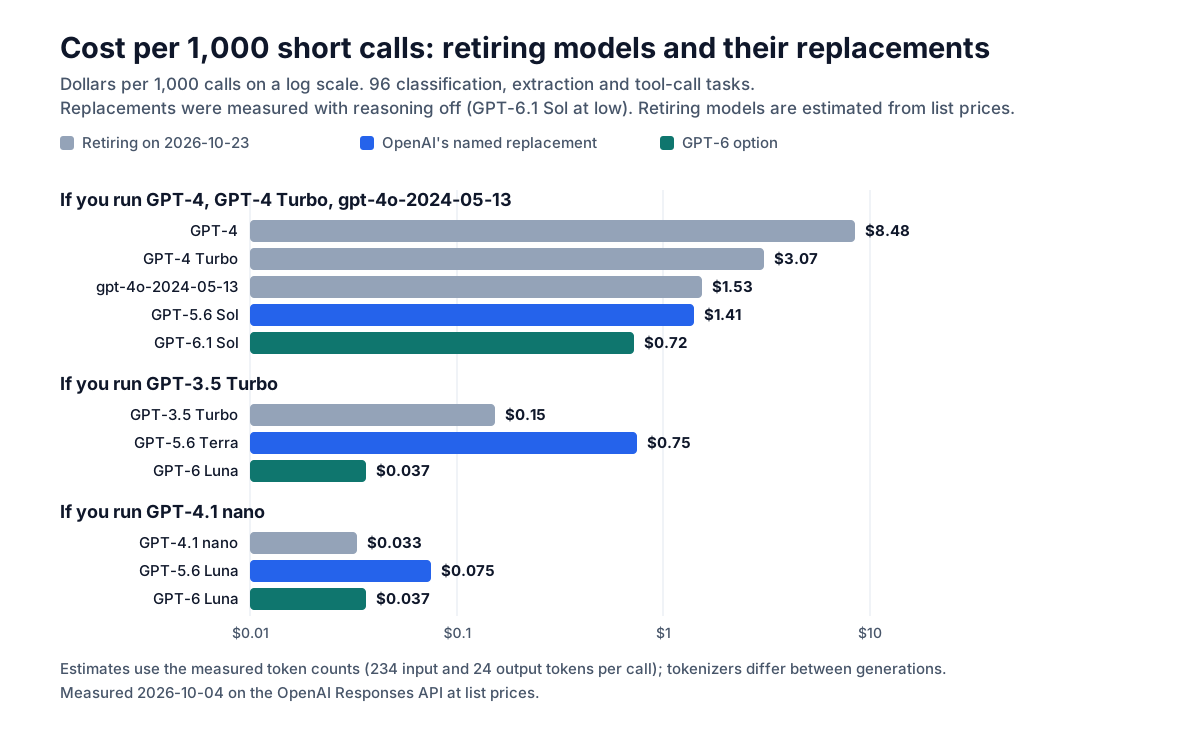
For GPT-4 and GPT-4 Turbo, any move is a saving. For gpt-4o-2024-05-13, GPT-5.6 Sol costs about the same and GPT-6.1 Sol half. For GPT-3.5 Turbo, the named replacement costs 4.9 times as much and GPT-6 Luna a quarter. For GPT-4.1 nano, the named replacement costs 2.3 times as much and GPT-6 Luna about the same.
The o-series is not in this table. o1, o3-mini and o4-mini spend reasoning tokens we cannot measure, so only their list prices in the first table apply. For reasoning workloads, our GPT-6.1 Sol measurements cover 13 tasks at each effort setting.
Does the default reasoning effort raise the bill?
The default effort raises the bill a little on the Sol models and noticeably on the cheaper ones. Leaving reasoning.effort at its default added 5% to the cost of these calls on GPT-5.6 Sol and GPT-6.1 Sol, 22% on GPT-5.6 Terra, 34% on GPT-6 Luna and 42% on GPT-5.6 Luna, with no change in accuracy. The reasoning was small, 25 tokens per call at most, but on a call that only writes 24 tokens of answer it doubles the output.
from openai import OpenAI

client = OpenAI()
resp = client.responses.create(
    model="gpt-6-luna",
    reasoning={"effort": "none"},  # no hidden reasoning; use "low" on gpt-6.1-sol
    max_output_tokens=64,
    input="Classify the customer message into exactly one label: ...",
)
print(resp.output_text)
print(resp.usage.output_tokens, resp.usage.output_tokens_details.reasoning_tokens)
A small output limit, common in classification code written for GPT-3.5 Turbo, did not break anything here: with max_output_tokens at 64, all 200 calls returned the label, at the default effort too. A task that makes the model reason more could still use up a small limit before any answer is written, so check output_tokens_details.reasoning_tokens on your own calls.
Latency was the same across four of the five, a median of 2.2 to 2.4 seconds per call. GPT-6.1 Sol took 2.9 to 3.2 seconds.
OpenAI’s migration guide lists the request changes: temperature, top_p and top_logprobs must be removed unless the effort is none, GPT-6.1 Sol does not accept none, and tool calling with reasoning needs the Responses API.
Which replacement should you pick?
Pick by what the retiring model was doing, and treat OpenAI’s column as one option among several.
| You run | Pick | Why |
|---|---|---|
| GPT-3.5 Turbo for classification, extraction, routing | GPT-6 Luna with reasoning.effort: "none" | $0.037 per 1,000 calls against $0.75 on GPT-5.6 Terra; 96 of 96 correct on both |
| GPT-4.1 nano | GPT-6 Luna with effort none | $0.037 against $0.033 today; GPT-5.6 Luna costs $0.075 |
| GPT-4, GPT-4 Turbo or gpt-4o-2024-05-13 for short tasks | GPT-6.1 Sol at low, or GPT-6 Luna if a test on your data holds up | $0.72 against $1.41 on GPT-5.6 Sol, whose price is promotional |
| GPT-4 for long documents | GPT-6.1 Sol | it writes at GPT-5.6 Sol’s length for 59% less per document in our document test; GPT-6 Luna writes about half as much unless the prompt names the parts |
| Anything where each call must be fast | GPT-6 Luna or GPT-5.6 Sol | GPT-6.1 Sol was the slowest here, 2.9 to 3.2 seconds against 2.2 to 2.4 |
| o1, o3-mini, o4-mini | GPT-6.1 Sol at medium or higher | $2 / $10 lists below both named replacements ($4 / $20 and $2 / $12), though above o3-mini and o4-mini’s $1.10 / $4.40; measure on your own tasks, since reasoning cost depends on the task |
Fine-tuned models cannot be moved by changing a model name. OpenAI lists a base model for each, and the fine-tune has to be rebuilt or replaced with a prompt. We did not test that.
Our tasks are short and have one right answer. Before switching, run your own prompts through the candidate and compare the outputs; a cheaper tier that is right on 96 of our tasks can still differ on yours.
FAQ
When does GPT-4 shut down in the API?
GPT-4, GPT-4 Turbo and the gpt-4o-2024-05-13 snapshot shut down in the OpenAI API on 2026-10-23, together with GPT-3.5 Turbo, GPT-4.1 nano, o1, o1-pro, o3-mini and o4-mini. OpenAI announced the date on 2026-04-22.
What replaces GPT-3.5 Turbo? OpenAI names GPT-5.6 Terra as the replacement for GPT-3.5 Turbo, at $2 / $12 per million tokens against $0.50 / $1.50. In our test GPT-6 Luna, at $0.10 / $0.50, was correct on the same 96 short tasks for a twentieth of GPT-5.6 Terra’s cost.
Is GPT-6 Luna cheaper than GPT-3.5 Turbo? GPT-6 Luna lists at $0.10 input and $0.50 output per million tokens, a fifth and a third of GPT-3.5 Turbo’s $0.50 and $1.50. With reasoning off, 1,000 short calls cost $0.037 in our test, against about $0.15 at GPT-3.5 Turbo’s prices.
Related measurements: GPT-6.1 Sol vs Claude Sonnet 5.5, GPT-6 Luna vs GPT-5.6 Luna, and GPT-5.6 cost levers.